Raising bilingual child — Tamil and English, under one roof, from the very first week — is one of the most common things families ask us about. And the question almost always arrives with a worry attached to it. Will two languages confuse him? Will she start talking late? A neighbour has advised picking one language and sticking to it. A well-meaning relative has said English first, Tamil later, otherwise the child will struggle in school.
Here is the short answer, and it is a relieving one. A bilingual home does not confuse a baby, and it does not cause speech delay. The research has pointed the other way for decades. What two languages give your child is a brain that has been practising switching, sorting and paying attention since infancy — and a paati she can actually talk to.
The rest of this is the long answer: where the confusion myth came from, what really happens inside a bilingual brain, how to choose an approach that suits your particular household, and what to do when a child genuinely does need a closer look.
Where the confusion myth came from
It is worth knowing, because once you know, it stops having power over you.
The idea that bilingualism harms children comes largely from studies done a century ago, on immigrant children, tested in a language they were still in the middle of learning. Unsurprisingly, they scored lower than children tested in their mother tongue. The conclusion drawn was that two languages had damaged them. The far simpler explanation — that you cannot measure a child’s thinking through a language they have not yet mastered — took another fifty years to be widely accepted.
The myth survives today for a smaller, more everyday reason: code-mixing. When your two-year-old says “Amma, ithu what?” or “paal venum, please”, it looks like a jumble. It is easy to read it as a small brain fumbling between two systems. It is not. Mixing within a sentence is something bilingual adults do fluently and deliberately all over Tamil Nadu, all day. Your toddler is doing a simpler version of the same thing — reaching for whichever word arrived first, in a room where both languages are welcome. It is a sign of resourcefulness, not confusion.
Raising bilingual child brains: what actually happens
Babies arrive prepared for this. Newborns can already distinguish languages by their rhythm — they have been listening through the womb. In the first year, a baby’s brain quietly narrows down the sounds it treats as meaningful, keeping the ones its home language uses and letting the rest go. A baby hearing Tamil and English simply keeps two sets of sound categories open instead of one. There is no crowding. There is no competition for space.
What does build the brain, in one language or in five, is the back-and-forth. The Harvard Center on the Developing Child calls it serve and return: your baby babbles or points or looks, an adult responds, the baby responds back. That loop is the actual construction work of early development. Whether the return comes in Tamil or English matters far less than whether it comes at all — warmly, promptly, and often. This is exactly why we say at Brainy Indigo: develop the brain first, everything else follows.
Milestones do not shift because of a second language
Bilingual children hit the usual markers on the usual schedule. First words around twelve months. Roughly fifty words by two. Two-word combinations — “appa go”, “more paal” — somewhere in the second half of the second year.
The one thing that changes is how you count. A bilingual child’s vocabulary is spread across two languages, so counting only the English words will always make her look behind. Count both languages together. If she says paal but not milk, and dog but not naai, she has two words, not one. Researchers call this total conceptual vocabulary, and it is the only fair measure of a bilingual child.
The quiet advantage
Because a bilingual child is constantly deciding which language this particular person speaks, and suppressing the other one, she gets years of daily practice at something psychologists call executive function — holding a rule in mind, ignoring a distraction, switching tracks on demand. These are the same skills that later show up as sitting through a lesson, following three-step instructions and managing frustration. You are not adding a language subject. You are training attention.
Choosing an approach that fits your home
Raising bilingual child — in a real house, with real relatives and real evenings — is less about picking the right method than about picking an honest one. There are three approaches families commonly use, and none of them is the correct one. The correct one is the one your household can sustain without pretending.
- One parent, one language. Amma speaks Tamil, Appa speaks English, consistently. Clean and easy to explain to relatives. Works best when both parents are genuinely comfortable in their assigned language — and it fails quietly when one parent has to perform a language they do not feel at home in.
- Home language at home. Tamil inside the house; English arrives through school, playground and the world outside. For families in Coimbatore or Chennai, this is usually the sensible default, because English is already everywhere — it is Tamil that needs protecting. For families abroad, it is the same principle with the same logic: guard the language that has no other source.
- Time and place. Tamil at mealtimes and bedtime, English during play. Or Tamil on weekends. Looser, and perfectly workable, as long as the pattern is real rather than aspirational.
Underneath all three sits the thing that actually decides the outcome: how much live, interactive time each language gets. A language needs somewhere in the region of a quarter to a third of your child’s waking interaction to grow properly. Below that, it becomes a language she understands but does not speak — the familiar pattern in so many families where the child answers Tamil questions in English.
Which is why joint families are an advantage here, not a complication. Thatha and paati are unhurried, fluent, repetitive native speakers who will happily narrate the same story for the eleventh time. That is not old-fashioned. That is high-quality language input, freely available, and it is the single easiest way to top up Tamil in an English-heavy week.
One more reassurance: mixing your own languages in front of your child does not undo any of this. Consistency helps, purity is not required, and no family in Tamil Nadu speaks purely anything.
Growing both languages without screens
Under the age of two, children learn very little language from a screen, however educational it claims to be. A video cannot notice what your child is looking at, and cannot answer her. Language transfers through people. So the practical work of raising a bilingual child is mostly about talk, and mostly free.
- Narrate the ordinary. Cutting vegetables, folding clothes, hanging out the washing — say what you are doing, in whichever language that room belongs to. Your kitchen is a vocabulary lesson that needs no preparation.
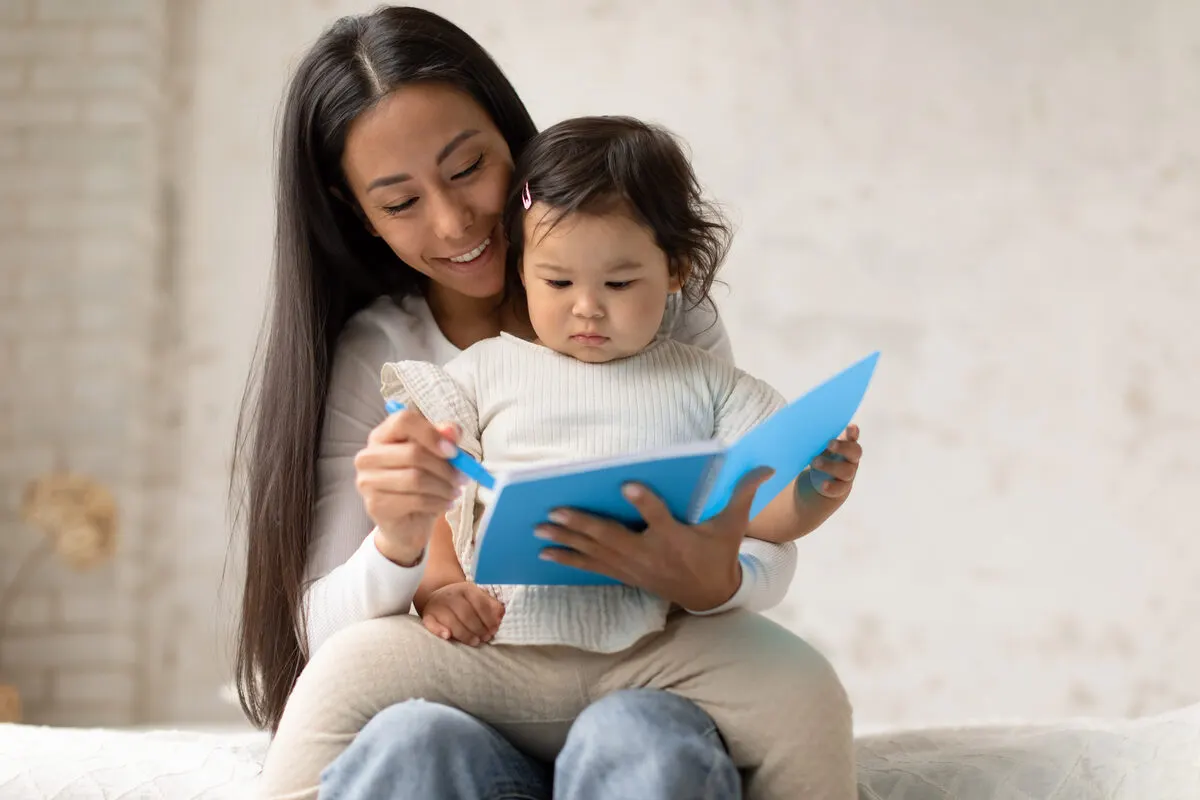
- Read the same book in both. You do not need a Tamil edition. Hold an English picture book and simply tell the story in Tamil, pointing as you go. Point and name, then wait — the waiting is where your child gets her turn.
- Sing. Thalattu, nursery rhymes, film songs, anything with a beat. Rhythm and repetition carry the sound patterns of a language better than almost anything else, and a child who cannot yet talk can still join in.
- Ask for stories from grandparents. Real stories, told aloud, with pauses and questions in them. This is the richest Tamil input most children will ever get.
- Recast instead of correcting. If she says “paal venum, please”, do not stop to fix it. Say back, warmly, “Milk venuma? Sari, milk edukkalam.” She hears the fuller version without ever being made to feel wrong.
- Name feelings in the language of comfort. Whichever language you naturally soothe her in is the one where emotional vocabulary should grow first. Let it stay the cuddle language.
Little of this needs a schedule. It needs noticing — which is the harder part, especially in the blur of the first two years. For families in our programs, Brainy Indigo Connect is the thread that keeps the journey connected: what you observe at home and what we see in sessions stay part of one continuous picture, rather than two separate ones. You can read more about Connect here.
When a bilingual child does need a closer look
Everything above is reassurance, and it is honestly meant. But reassurance should never be a reason to wait when something feels wrong — and the confusion myth does real damage precisely here, by giving families a comfortable explanation for a delay that deserved attention.
So, gently: bilingualism is never the cause of a language delay, which means it should never be the explanation for one either. It is worth speaking to someone if you notice:
- No gestures — no pointing, waving or showing — by around twelve months
- Very few words by eighteen months to two years, counted across both languages together
- Words that were there and have since disappeared
- Little response to her name, or any doubt at all about hearing — always have hearing checked first, because a mild, easily missed hearing loss is one of the most common reasons behind a delay
- Difficulty understanding simple instructions in the language she hears most
None of these mean something is wrong. They mean the picture deserves a proper look rather than another six months of waiting. If your child understands everything but says very little, we have written about that pattern in detail in this guide on the two-year-old who understands but does not talk.
The long view
Somewhere around three or four, the anxious years quietly end. The mixing sorts itself out. She works out who to speak Tamil to and who to speak English to, and does it without being told. And what she keeps is not just a second language — it is her grandmother’s stories in the original, a household she belongs to completely, and a brain that learned early how to hold two things at once.
So take this with you: raising bilingual child in a Tamil-English home was never a risk to manage. Two languages were never the risk. They were the gift.
Curious what live, guided sessions look like? Join a free online session with Early Enrichment Global — small groups, parents involved throughout, from wherever in the world you are.