Somewhere in your house right now there is a shelf of toys, and somewhere near it there is a baby playing with the box they came in. Every parent has watched this happen and felt slightly cheated. You needn’t. The best brain development activities for babies aged 6 to 12 months are almost never the expensive ones — they are made of steel tumblers, old newspaper, a cotton dupatta and ten unhurried minutes of your attention.
This is not a thrift argument. It is a developmental one. Between six and twelve months your baby’s brain is forming new connections at a rate it will never match again, and what drives that building is not stimulation for its own sake — it is responsive interaction with real objects and real people. Here are ten brain development activities for babies you can start today, what each one is actually constructing inside your baby, and how to tell it is working.
Why everyday play beats fancy toys
A toy that lights up, sings and rotates on its own is doing all the interesting work already. Your baby’s job is reduced to watching. A steel tumbler does nothing at all until your baby bangs it, drops it, turns it over, discovers it makes a different sound on the floor than on the diwan — and every one of those discoveries is a small experiment your baby ran themselves.
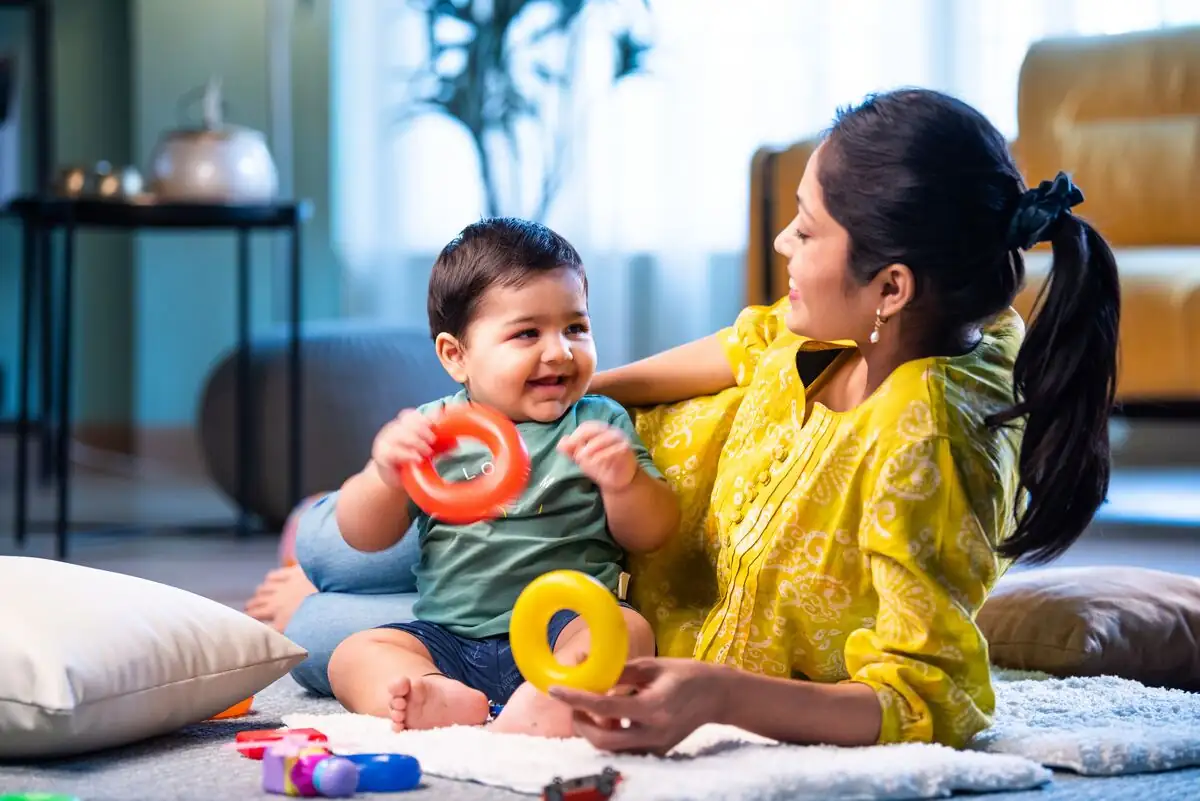
That difference matters more than it sounds. The Harvard Center on the Developing Child describes the core mechanism of early brain building as “serve and return” — the baby does something, an adult responds, the baby does something back. Open-ended household objects invite that loop. Closed-loop electronic toys tend to replace it.
This is why the most effective brain development activities for babies tend to be the plainest ones. There is also a practical advantage in most Indian homes. Household objects are already in the room, already familiar, and already the things your baby is reaching for. You are not adding a new routine. You are noticing the one that is happening anyway.
Brain development activities for babies: 10 ideas from around your house
These brain development activities for babies are roughly ordered from younger (around six months) to older (closer to twelve). Skip what doesn’t suit your baby today and come back to it in three weeks — the readiness changes fast at this age.
- 1. The tumbler orchestra. Two steel tumblers, one wooden spoon, baby sitting supported on the floor. Let them bang, drop, and bang again. Then you copy their rhythm back. This is a conversation before it is music.
- 2. The texture basket. A shallow vessel holding five safe things with completely different surfaces — a coconut shell half, a silicone spatula, a cotton cloth square, a steel spoon, a loofah. Let your baby lead. Name each thing as they pick it up.
- 3. The dabba drop. One large steel dabba and a few objects too big to swallow — a large ladle, a plastic bangle, a katori. Dropping something in and hearing it land is one of the great intellectual events of the first year.
- 4. The dal shaker. A small plastic bottle, a handful of dal or rice, lid glued or taped shut and checked before every use. Shake it, hide it under a cloth, shake it again. Sound plus mystery.
- 5. Newspaper tearing. Old newspaper only, supervised closely, and stop the moment it starts heading mouthward. Tearing is a two-handed job requiring both sides of the body to pull in opposite directions — much harder than it looks.
- 6. The dupatta pull. Stuff a dupatta or two cotton scarves loosely into an empty tissue box or a wide-mouthed vessel and let your baby haul them out. Endlessly repeatable. Refill and repeat.
- 7. Cushion mountain. Two or three pillows on the floor in a low, uneven range. A baby who is crawling will climb over them; a baby who is not yet will push against them. Both are exactly the point.
- 8. Mirror floor time. Prop a safe mirror, or sit in front of the almirah mirror with your baby on your lap. Wave, make faces, say their name. Self-recognition arrives later, but the fascination starts now.
- 9. Narrated kitchen work. Baby on the floor with a couple of safe vessels while you cook, and you simply talk: “Now the onions. Hot, careful. Amma is stirring.” Ordinary running commentary is one of the most powerful language inputs there is.
- 10. Towel peek-a-boo. A thin cotton towel over your face, then theirs, then over a favourite object. Around eight or nine months you’ll see the shift — they stop being surprised and start actively pulling the towel away, because they now know you were there all along.
Two safety notes, briefly. Nothing small enough to pass through a toilet-roll tube. And these are all together-activities, not leave-them-to-it activities — the adult in the room is not supervision overhead, they are half the activity.
What each one is actually building
It helps to know what these brain development activities for babies are actually constructing, because from the outside all ten of them look like a baby making a mess.
Cause and effect
The tumbler orchestra, the dabba drop and the dal shaker all teach the same enormous lesson: I did that. An action produced a result, and the result repeats. This is the seed of agency, and it underlies everything from problem-solving to persistence years later.
Object permanence
Towel peek-a-boo and the hidden shaker build the understanding that things continue to exist when they are out of sight. This is the same capacity that makes separation easier to manage later — a baby who knows Amma still exists behind the door is a baby with something to hold on to.
Grip, release, and the road to writing
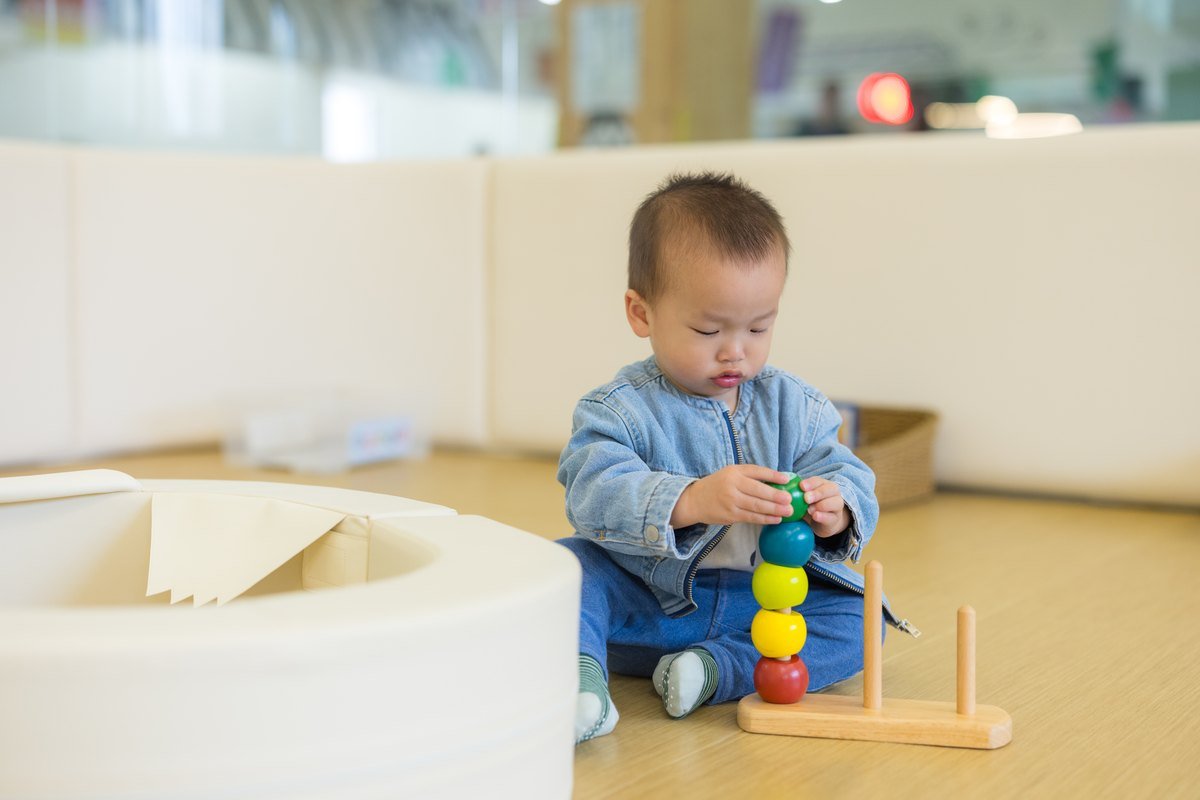
Newspaper tearing, the dupatta pull and picking objects out of the texture basket refine the pincer grasp and — just as importantly — the ability to deliberately let go. Release is a separate skill from grasping and it develops later. Every voluntary drop is practice. Past the first birthday the same skill moves on to spoons, stacking and scribbling — these fine motor skills activities for toddlers pick up exactly where this list leaves off.
Two sides of the body, working together
Tearing, cushion climbing and crawling all require the left and right halves of the body to coordinate. That cross-body communication supports balance, later handwriting, and the smooth eye movements reading will need. It is one of the quiet reasons floor time matters so much in this window — the same reason we make such a fuss about tummy time in the early months.
Language, long before words
Narrated kitchen work, naming textures and copying rhythms are all language activities, even though your baby cannot yet say anything back. Babies build vocabulary they will use months later. If your family speaks Tamil and English, use both, freely — hearing two languages does not confuse or delay a baby, and mixing them in the same sentence is fine.
How to know it’s working
You will not see results in a week, and you should not go looking for them. But across a month or two, watch for these:
- Repetition with variation. Not just banging the tumbler, but banging it on the floor, then the mat, then their own knee. That is a baby testing a hypothesis.
- Looking at you after something happens. The drop, then the glance up. That check-in is social referencing, and it is a very good sign.
- Anticipation. They start laughing before the towel comes off.
- Longer stretches. Attention at this age is measured in seconds — but four minutes with the dupatta box, where it used to be forty seconds, is real growth.
- Transferring a skill. They learn to pull scarves out of a box, and next week you find them pulling clothes out of a drawer. Annoying. Also excellent.
And if some days none of this happens because everyone is tired and the baby only wants to be held — that is fine. Being held is also brain development. Consistency across weeks matters far more than any single afternoon.
If you’d like this more structured, our Activity Library organises brain development activities for babies by age and by the skill they build, and our guide to toddler brain development activities picks up where this one leaves off, past the first birthday. Families in the Brainy Early Years programme go through this age-by-age with a guide, and Brainy Indigo Connect is the thread that keeps the journey connected from one stage to the next.
Develop the brain first. Everything else follows.
See the Brainy Early Years play kits — Brainy Complete, ten age-matched kits delivered to your door.