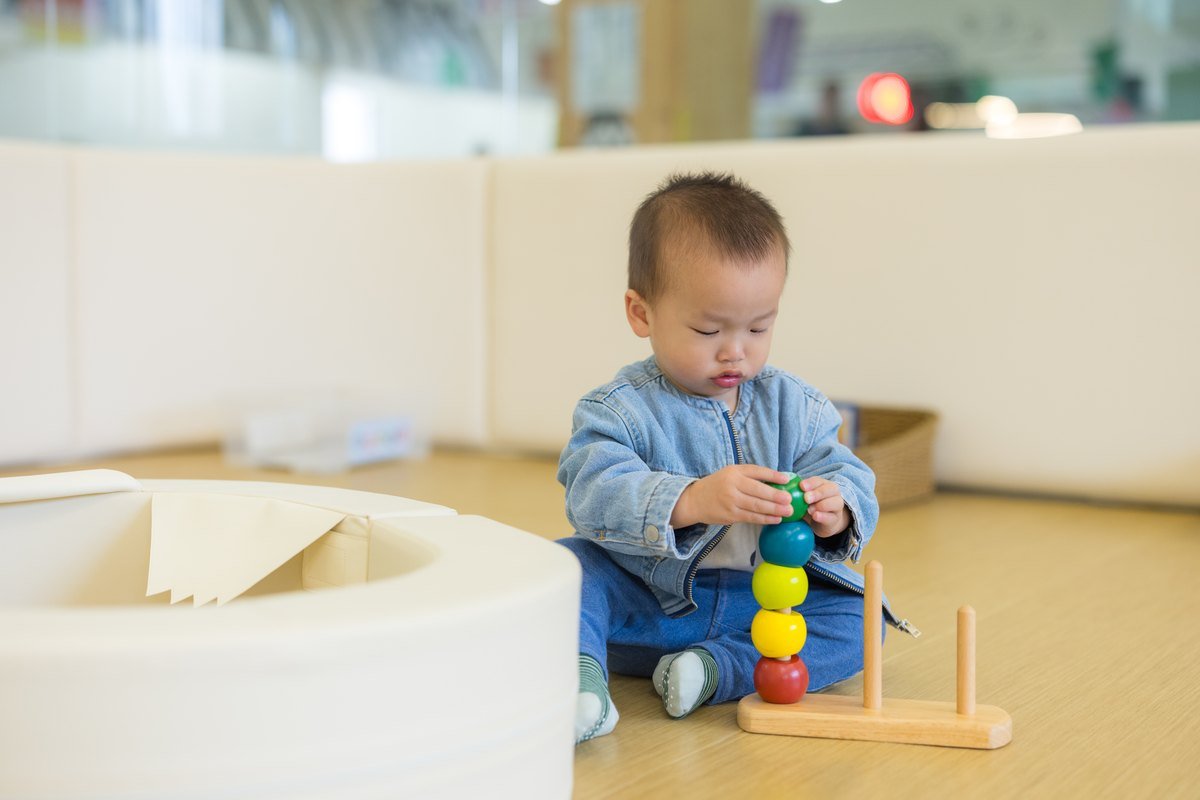

Somebody at a family function will ask. It is almost guaranteed. Your baby is ten months old, sitting happily on your lap, and an aunt will lean over and say, “Not walking yet?” — and something in your stomach will drop, even though you know better.
So let us answer the question properly. When do babies start walking? Most take their first independent steps somewhere between 9 and 18 months, and every single month in that range is normal. Not “acceptable”. Normal. A baby who walks at nine months and a baby who walks at sixteen months are both doing exactly what they are supposed to be doing, and by their third birthday you will not be able to tell which was which.
Here is the fuller picture: how walking is actually built, what the range really looks like, when a delay is worth a conversation, and what genuinely helps.
Walking is the last step, not the first
Here is what most milestone charts obscure. Walking is not a skill that appears one day. It is the visible top of a stack your baby has been assembling for the better part of a year. The rough order:
- Head control (2–4 months). Before anything else can happen, the head has to stay steady. This is what all that time on the tummy was building.
- Rolling (4–6 months). The first time your baby moves their whole body somewhere on purpose. Trunk muscles, and the discovery that the body can be aimed.
- Sitting without support (6–8 months). Balance, and a completely new view of the room. Hands become free.
- Crawling, or shuffling, or rolling everywhere (7–10 months). Real locomotion. Also the first time the two sides of the body have to coordinate with each other — which matters more than it sounds.
- Pulling to stand (8–10 months). Usually against the sofa, a cot rail, or your leg. Leg strength meets ambition.
- Cruising (9–12 months). Sideways along the furniture, hands gripping. This is where balance gets rehearsed in a low-risk way.
- Standing alone (10–14 months). Often accidental at first — they let go to reach for something and stay upright, and look completely astonished.
- First independent steps (9–18 months). Two or three wobbly ones, then a sit-down. Then, within weeks, everywhere.
Some babies skip a rung. Plenty never really crawl — they bottom-shuffle, commando-crawl on their elbows, or go straight from sitting to pulling up. That is not a problem in itself. What matters is that the underlying capacities are being built somehow: strength, balance, and coordination between the two halves of the body.
Our guide to baby development milestones month by month lays out how these stages interlock across the whole first year, if you want to see where your baby sits in the chain.
When do babies start walking? The normal range is wider than you think
Two babies. One walks at ten months, the other at sixteen. Both are healthy, both are typical, and the six months between them tells you almost nothing about either child. Broadly:
- 9–11 months: Early. Around one in four babies. Often lighter, often second or third children with older siblings to chase.
- 12–14 months: The biggest group. If you are picturing an “average”, it lives here.
- 15–18 months: Later, and still within normal. A meaningful number of perfectly typical children walk in this window.
What pushes a baby towards one end or the other is mostly unglamorous. Body build — a heavier, longer baby has more to lift. Temperament — cautious babies practise longer before committing. Birth history — babies born early are measured from their due date, so a baby born two months early who walks at 16 months is really walking at 14. Family pattern — if you and your partner both walked late, there is a fair chance your child will too.
And then there is opportunity, the one thing you can actually influence: a baby who spends most of the day on the floor gets more practice than one who spends it in arms, a walker, or a bouncer.
One myth worth retiring: baby walkers do not help babies walk. They hold the child in a position the body has not earned, do the balancing for them, and cut into the floor time where the real work happens. Most paediatric bodies discourage them, on safety grounds as well as developmental ones. A push-along toy the child steers themselves is a different thing entirely, and genuinely useful.
What walking is doing to the brain
It is tempting to file walking under “physical” and move on. But the month a child starts walking tends to be a month when several other things shift at once, and that is no coincidence.
An upright, mobile child gets a fundamentally different stream of information than a crawling one. Their hands are free while they move. Their eyes are a foot higher, so they can see across the room and plan a route to something. And they can carry an object to a person — which turns out to be a big deal, because carrying things to adults creates a burst of shared attention and naming: “Oh, you brought me the spoon!”
The Harvard Center on the Developing Child describes early development as serve and return — the back-and-forth between a child and the adults around them, which shapes the brain’s architecture. A newly walking child serves far more often. They bring you things, point across the room, and lead you by the finger. The motor milestone opens a social and linguistic door.
Which is why the answer to “when do babies start walking” matters less than what happens around the walking. A child who walks at fifteen months into a house full of conversation and floor time is in a better position than one who walks at ten into a screen.
When late walking is worth a conversation
When do babies start walking later than expected, it is usually just that — late walking, and nothing more. But a few signals are worth raising with your paediatrician — not urgently, not with alarm, but as a question at a routine visit. Asking early is easier than asking late, and the usual outcome of asking is reassurance. Worth mentioning:
- No independent walking by 18 months. This is the usual threshold for a proper look, especially if the child also is not cruising along furniture.
- Not bearing weight on the legs by around 12 months — legs buckling or lifting away when you hold them upright on the floor.
- Consistent asymmetry. One side doing noticeably more than the other: always leading with the same leg, one arm held differently, only ever turning one way.
- Muscle tone that feels off to you. Unusually stiff and hard to bend, or unusually floppy. Parents are good at noticing this even when they cannot name it.
- Losing a skill. A child who was pulling to stand and has stopped, or who was cruising and no longer does. Regression always warrants a check.
- Delays clustering. Late walking on its own is usually nothing. Late walking alongside very few words, little pointing, or limited response to their name is a different picture, and the combination is what matters.
Note what is not on that list: walking at 15 months. Walking later than the neighbour’s child. Not crawling. Bottom-shuffling. Slightly bowed legs in a toddler. Toe-walking that comes and goes in the first months of walking. Flat-looking feet — the arch does not really appear until three or four. All extremely common, all usually nothing.
If you would like something more structured than your own instinct, our free Child Development Snapshot walks you through age-appropriate expectations across motor, language, cognitive and social development, and tells you plainly whether what you are seeing is within range.
What actually helps
You cannot teach a baby to walk. The nervous system is on its own schedule. What you can do is make sure your baby has the opportunity and the strength, and then get out of the way.
Floor time, and lots of it. The single biggest lever. A clean mat or bedsheet, minimal furniture in the way, long stretches of unstructured time. Every hour on the floor is practice; every hour in arms, a bouncer or a pram is not. In a joint family this is easier — there are more people happy to sit on the floor and be a destination.
Give them something to cruise along. A low sofa, a diwan, a row of sturdy stools, a coffee table pushed against a wall. Cruising is where balance gets rehearsed. Put an interesting object at the far end.
Barefoot indoors. The sole of the foot is full of sensors, and a barefoot baby gets far better feedback about where the floor is. Shoes are for outside and for protection, not for support — soft, flexible and thin-soled when you do need them.
Hold hands the right way. If you walk your baby around by their hands, hold them low — around their own shoulder height, not stretched above their head, which pulls the body out of its natural balance. Better still, offer two fingers to grip rather than gripping their wrists, so they control how much support they take.
Squatting, climbing, and standing play. Put toys on a low table so they have to stand to play. Let them squat to pick things up and rise again — that is a serious leg workout.
Push toys, not walkers. A weighted push-along cart, or a sturdy dining chair pushed across the floor, lets the child provide their own balance while getting a little support.
Resist the urge to hover. Small falls onto a padded bottom are how balance is calibrated. If you catch every wobble, you remove the information. Clear the sharp corners, then let them get on with it.
Our Activity Library has month-by-month movement activities for the 8–18 month window, if you want something more specific than “let them play on the floor”.
The bigger picture
Walking is the milestone everyone photographs, but it is one link in a chain that started with a wobbly head at two months and runs on into running, climbing and holding a pencil. Strength feeds balance, balance frees the hands, free hands feed exploration, exploration feeds language.
That chain is the thinking behind Brainy Early Years, our developmental guidance programme for children from birth to 30 months. It works month by month through the window when the brain is building fastest, with Brainy Indigo Connect as the thread that keeps the journey connected — so what you noticed at seven months is still in view at fifteen.
Develop the brain first. Everything else follows.
And the next time someone at a function asks why your baby is not walking yet, you can tell them, quite truthfully, that the baby is busy building the thing that walking sits on top of.
Check your baby’s milestones — take the free Child Development Snapshot and see exactly where your child is across every area of development, in about ten minutes.