
Few things fill a parent’s heart — and search history — quite like watching a baby grow. If you’ve been wondering about baby development milestones 0 to 12 months, here is the reassuring truth: milestones are not a race, a test, or a report card. They are simply signposts — a way of noticing how your baby’s brain is wiring itself, one experience at a time. This month-by-month guide walks you through the first year calmly: what tends to happen when, what counts as normal variation, and the small number of signs genuinely worth acting on.
On this page
- What milestones really are (and aren’t)
- The month-by-month guide
- Red flags vs normal variation
- How to track without obsessing
- What helps development along
- Milestones in a Tamil household
- Questions parents ask
- Where is your baby right now?
What Milestones Really Are (and Aren’t)
A milestone is a skill most babies reach within a window of time — not on a fixed date. Rolling over, for example, can arrive anywhere between 3 and 7 months, and both ends of that range are perfectly healthy. In the early years, more than one million neural connections form every second, and every baby builds those connections along a slightly different path.
Milestones are also not just physical. Development unfolds across several domains at once — gross motor, fine motor, language, cognitive, social and emotional. A baby who is slower to crawl may be racing ahead in babbling. That trade-off is common and normal. The fine motor thread in particular keeps going long after the first birthday — fine motor skills activities for toddlers follows it from one to five.
Baby Development Milestones 0 to 12 Months: The Month-by-Month Guide
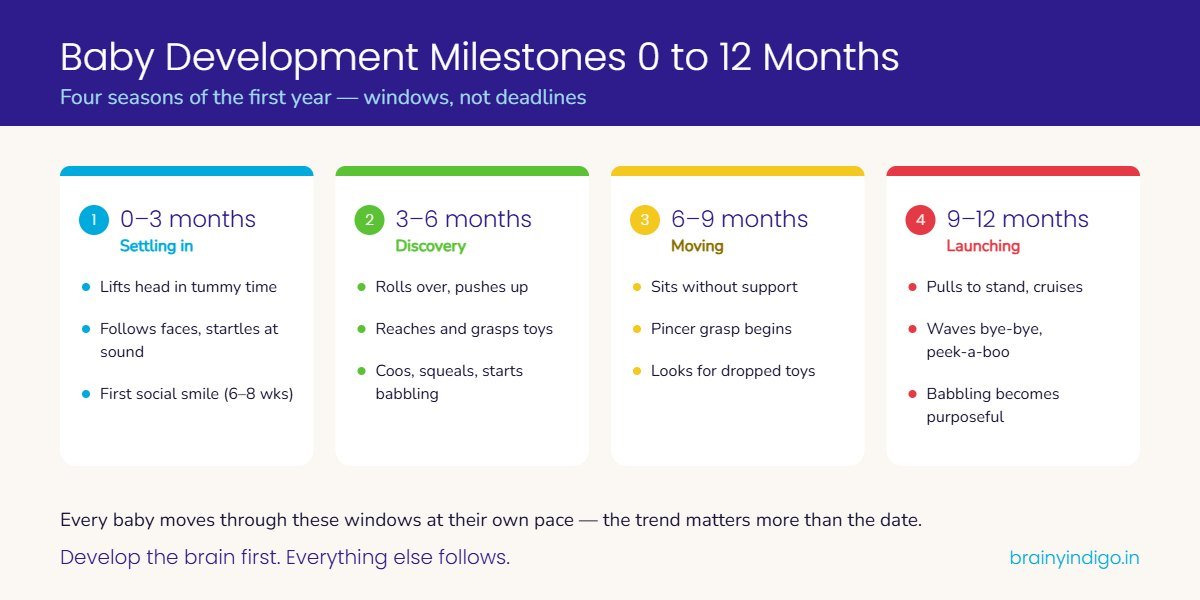
0–3 months: The settling-in season
- Body: lifts head briefly during tummy time; movements gradually become smoother.
- Senses: follows faces, startles at sounds, begins tracking moving objects.
- Connection: the first real smile — usually between 6 and 8 weeks — and calming at a familiar voice.
This season is less about skills and more about security. Every feed, cuddle and eye-lock is building the foundation for everything that follows.
3–6 months: The discovery season
- Body: rolls over, pushes up on forearms, reaches and grasps toys.
- Voice: coos, squeals, and begins babbling — “aah”, “ooh”, early consonants.
- Play: everything goes to the mouth (that’s learning, not mischief), laughs out loud.
6–9 months: The moving season
- Body: sits without support, may start crawling — though some babies scoot, roll, or skip crawling entirely.
- Hands: passes objects between hands; the pincer grasp (thumb and finger) begins.
- Mind: looks for dropped toys — object permanence is arriving; may show stranger wariness, a healthy sign of attachment.
9–12 months: The launching season
- Body: pulls to stand, cruises along furniture; a few babies take first steps (many wait until 15–18 months).
- Voice: babbling turns purposeful — “amma”, “appa”, and maybe a first true word.
- Mind: waves bye-bye, plays peek-a-boo, understands simple words like “no” and “come”.
Red Flags vs. Normal Variation
Most differences in baby development milestones 0 to 12 months are just that — differences. Late walking runs in families. Quiet babies often become talkative toddlers. However, a few signs are worth discussing with your paediatrician or a child development expert, not because they confirm a problem, but because early guidance always helps:
- Not responding to loud sounds or familiar voices by 3–4 months
- Not making eye contact or smiling socially by 3–4 months
- Very stiff or very floppy muscles across several months
- No babbling by 9–10 months, or loss of skills a baby previously had
- Not bearing weight on legs with support by 12 months
If language is your worry, our guide on late talkers and speech milestones from 0–3 goes deeper into what’s typical and when to seek help.
How to Track Milestones Without Obsessing
Tracking baby development milestones 0 to 12 months should reassure you, not haunt you. There is a healthy middle path between ignoring development and refreshing a checklist every night. Three habits keep it calm:
- Watch the window, not the date. Note the month a skill typically arrives, then give it a generous margin before wondering.
- Look at the trend. A baby steadily gaining skills — even slowly — is usually developing well. It is plateaus and losses that matter more than pace.
- Write it down somewhere that lasts. Memories blur quickly. Families in our programs use Brainy Indigo Connect, the thread that keeps a child’s whole developmental journey connected — every observation becomes part of one growing story you can actually see.
And remember the bigger picture: 90% of brain development happens before age six. The first year is not a test your baby can fail — it is a window you get to enjoy. Develop the brain first. Everything else follows.
What Helps Baby Development Milestones 0 to 12 Months Along
You do not need flashcards, classes or expensive toys. Almost everything that builds a baby’s brain in the first year is free, and most of it you are already doing.
Serve and return. Your baby coos; you coo back. She looks at the fan; you look too and say “fan”. These tiny exchanges are the single most powerful thing you can do — they are how neural circuits get built and strengthened. A baby does not need you to be entertaining. She needs you to be responsive.
Floor time beats gear time. Babies who spend waking time on a firm surface build trunk strength faster than babies who move between car seat, bouncer and walker. Tummy time from the early weeks — a few minutes at a stretch, several times a day — quietly powers rolling, sitting and crawling later.
Narrate the ordinary. “Amma is pouring water.” “Now the light is on.” Babies learn language months before they produce it, and the number of words they hear in the first year predicts vocabulary later. Live speech counts; background audio does not.
Read, even to a newborn. Board books at three months are about your voice and the closeness, not the story. By nine months your baby will be patting the pages, which is exactly the point.
Follow the baby’s lead. If she is staring at the ceiling fan, that is her curriculum for the next two minutes. Interrupting to redirect her to a “learning toy” teaches less than joining her where she already is. Our activity library is organised the same way — by what a baby is already trying to do, not by what a chart says she should be doing.
Milestones in a Tamil or Multilingual Household
Most families in Coimbatore are running two or three languages at once — Tamil from paatti, English from a cousin or a screen, a blend of both from you. Parents often worry this will slow the first words down.
It does not. Growing up multilingual does not delay language milestones. What it changes is how you count: your baby’s vocabulary is the total across every language, not the count in one. Amma, paal, thatha, vaa, ball and bye is six words, not two.
Joint families have a real advantage here. More adults means more serve-and-return partners, more faces to read, and more voices to distinguish — all of which feed exactly the circuits the first year is building. The flip side is more comparison. When four relatives have opinions about why your nine-month-old is not walking yet, the noise can drown out what the baby is actually doing.
One practical note on gestures: in many Indian households a side-to-side head tilt means yes or agreement, not refusal. If you are reading an imported milestone chart that lists “shakes head for no” around twelve months, do not be alarmed if your baby’s version looks different. The skill being measured is communicative intent, and that shows up in whatever gestures your household actually uses.
Questions Parents Ask About Baby Development Milestones 0 to 12 Months
These are the questions parents bring us most often in the first year.
My baby is not crawling at nine months. Should I worry?
Usually not. Crawling has one of the widest ranges of any milestone, and a meaningful number of babies skip it entirely — they scoot on their bottom, roll where they want to go, or go straight from sitting to pulling up. What matters more is whether your baby is finding some way to move herself towards something she wants, and whether new skills keep appearing.
Do premature babies follow the same milestone chart?
No, and this trips up a lot of families. For babies born early, use corrected age — age from the due date, not the birth date — for roughly the first two years. A baby born two months early who is doing eight-month things at ten months is exactly on track.
Does screen time affect development in the first year?
The concern is less about the screen and more about what it replaces. A television running in the background measurably reduces the back-and-forth talk in a room, and that talk is the raw material of language. If you want the detail, our piece on what neuroscience says about screen time goes further.
Everyone compares my baby to their cousins. How do I handle it?
Comparison is the fastest way to turn a normal first year into an anxious one. Two babies at the same birthday party can be five months apart on walking and both be perfectly typical. If it helps, keep your own record and compare your baby only to herself last month.
When does a wide range stop being a wide range?
When skills plateau for a long stretch, when a baby loses something she could clearly do before, or when several domains lag together rather than one. Those are the patterns worth a conversation — and if your worry is specifically about speech, the same logic carries into the toddler years, which we cover in what it means when a two-year-old understands but is not talking.
Wondering Where Your Baby Is Right Now?
Take our free Child Development Snapshot — a gentle, age-banded look at your child’s development across five domains. Five to seven minutes, warm plain-language results, and no test anxiety (for either of you).