Nobody warns you that one of the most useful things you will do for your baby this year involves putting them face-down on a mat and then watching them complain about it.
Tummy time for babies has a bit of a reputation. Parents are told to do it, most are not told why, and almost everyone is told a number of minutes that sounds either impossible or pointless. Meanwhile the baby lasts forty seconds and then makes their feelings extremely clear.
So here is the honest version: what tummy time for babies is actually building, when to start, roughly how much, and what to do when your baby hates it. No stopwatch, no guilt.
Why tummy time for babies matters more than it looks
From the outside it looks like nothing. A baby lies on their front, wobbles, lifts their head an inch, puts it down again. Not much of a workout.
Underneath, quite a lot is happening.
The neck and shoulders. Lifting the head against gravity is the first big strength task of your baby’s life. Those muscles are what later hold the head steady while the eyes track a moving object, and steady head control is what makes visual tracking, and eventually reading, possible.
The trunk and core. Sitting without toppling, rolling deliberately rather than by accident, crawling, pulling to stand — all of it runs through the same set of trunk muscles that tummy time is quietly loading.
The hands. This one surprises people. Weight-bearing through the forearms and open palms is how the arches of the hand develop. Those arches are what eventually allow a pincer grasp, then a spoon, then a pencil. A baby pushing up on their elbows is doing early handwriting preparation, five years ahead of schedule.
The brain. Every new position gives the brain a fresh stream of information — where the body is in space, how much effort a movement takes, what the world looks like from four inches up instead of flat on the back. The Harvard Center on the Developing Child describes early development as brain architecture being built connection by connection, with the earliest experiences forming the foundation everything else sits on. Movement is one of the raw materials.
There is also a practical reason. Since safe-sleep guidance moved babies onto their backs for sleeping — which was the right call and has saved a great many lives — babies simply spend far less time on their fronts than they used to. Tummy time for babies is how that gets balanced out, and it also helps prevent the flat spot on the back of the head that comes from long stretches in one position.
When to start, and how much
You can start in the first week home. Genuinely — a full-term, healthy newborn can begin tummy time from day one, in the gentlest possible form.
Here is a rough shape. Treat it as a direction, not a target.
- 0–4 weeks: One to two minutes, two or three times a day. Mostly chest-to-chest — you lie back, baby lies on you. This counts. It is the easiest version and often the only one a newborn will tolerate.
- 1–2 months: Three to five minutes, three or four times a day. You can start moving to a firm flat surface, with a rolled towel under the chest if the head is heavy.
- 2–3 months: Around 10–15 minutes total across the day. Most babies begin lifting the head to 45 degrees and holding it.
- 3–4 months: 20–30 minutes total. Propping on forearms, chest clear of the floor, head steady and turning to follow you.
- 4–6 months: Often an hour or more, and by now you are not really counting — the baby is pushing up on straight arms, reaching for things, rocking, and starting to plot how to move across the room.
Three things worth saying about those numbers.
They are cumulative. Six spells of five minutes is the same as thirty minutes, and much easier on everyone. Short and frequent beats long and grim.
They are averages. Babies vary enormously, and a baby who was early or who has been unwell may take longer to get going. The trend matters more than any single week.
And after a feed is a bad idea. Give it half an hour, or you will find out why. Good windows are after a nappy change, after a nap, or during the alert stretch in the morning when your baby is most willing to be interested in things.
How to make it something your baby enjoys
The single biggest predictor of how tummy time for babies goes is whether your face is at floor level.
A baby on their front, alone on a mat, has a view of the floor and nothing else. A baby on their front with a parent lying down nose-to-nose has a reason to lift their head. Get down there. That is the technique.
Beyond that, things that reliably help:
- The chest-to-chest start. Lie back on the bed or floor, put your baby on your chest facing you. Skin contact, your heartbeat, your face right there. Newborns accept this when they will accept nothing else.
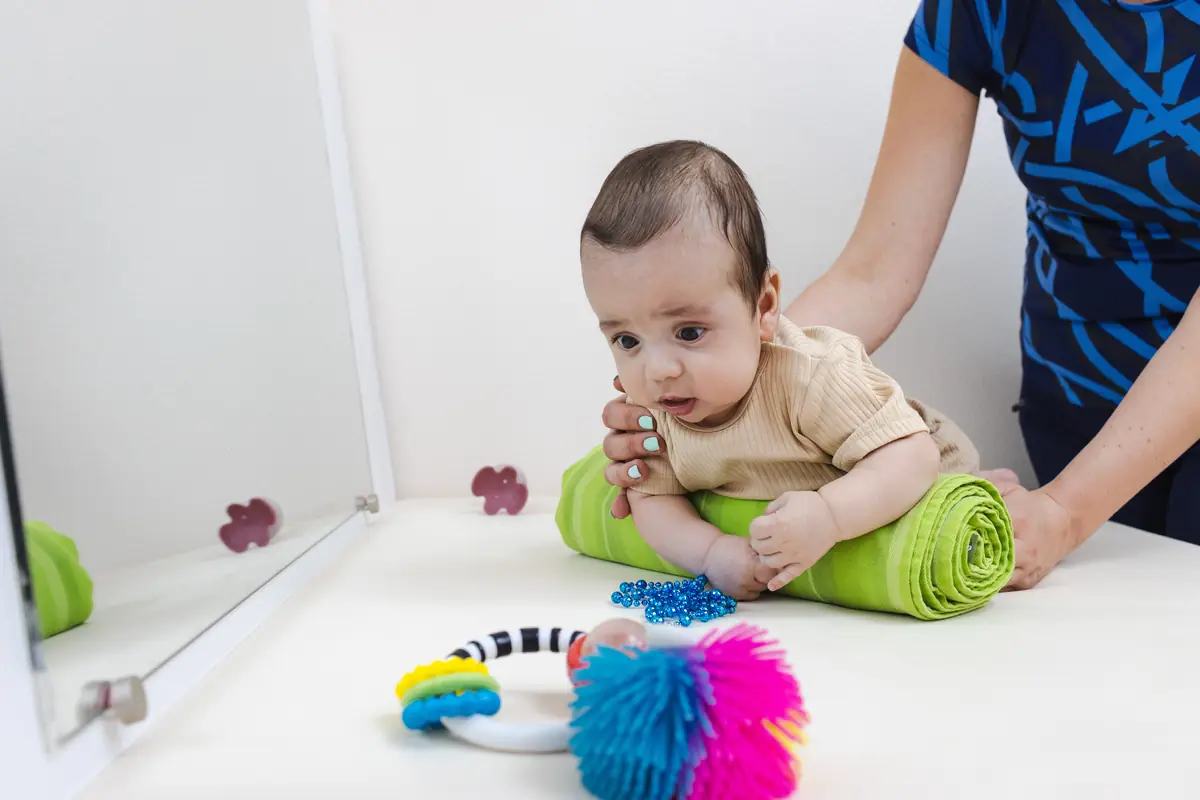
- A rolled towel or thin dupatta under the armpits. Not under the tummy — under the chest, with the arms forward over the roll. This takes some of the weight off and lets a young baby see more, which is usually the whole problem.
- A mirror. A safe, unbreakable one propped in front of them. Babies will hold their heads up considerably longer to look at a face, even their own.
- A high-contrast object just out of reach. Black-and-white patterns work best in the early months. Later, anything they want to grab: a steel katori, a bunch of bangles on a ring, a scrunched-up cotton cloth.
- Across your lap or forearm. Lay the baby tummy-down across your thighs while you sit, and pat their back. A gentler version that still loads the neck a little, and useful for babies with reflux.
- Change the floor. A cotton bedsheet, a mat, a soft blanket, the cool floor in the afternoon. Different textures give different information, and novelty buys you another minute.
In a joint family this is easier than it looks, because you have more laps. Thatha lying on the floor with the baby is tummy time. Paatti with the baby propped on her legs is tummy time. Spread it across the people in the house and it stops being one more thing on your list. The 15 minutes assembles itself out of ordinary afternoons.
Our Activity Library has age-matched positions and props for each of these months if you want something more specific than “put a toy in front of them”.
What to do when your baby hates it
Some babies protest. This is common and it does not mean you should stop.
What it means is that the version you are offering is too hard right now. Adjust rather than abandon.
Shorten it drastically. Thirty seconds, then pick them up while they are still doing fine — not after they have started crying. You want them to learn that this position ends well. Ten cheerful thirty-second goes will get you further than one four-minute battle.
Prop them higher. The towel roll, or your chest at a recline. Most protest is about the head being heavy and the view being boring, and both are fixable with a few inches of elevation.
Check the timing. Hungry, overtired, or just-fed babies will not cooperate with anything. Try the same thing an hour later and it can be a different baby.
Keep talking. Sing, narrate, make the noises you make. Your voice from close by is doing more work than any toy.
And stop when they are genuinely distressed. Grumbling and effortful noises are the sound of work being done, and it is fine to encourage through those. Real crying is a no, and pushing through it just teaches them that this position is where bad things happen. Pick them up, cuddle, try again after the next nap. You have months.
A few things are worth mentioning to your paediatrician at a routine visit, not as an emergency but as a question: if by around four months your baby still cannot lift their head while on their front, if they consistently turn their head to only one side, if one arm does noticeably more work than the other, or if their body feels unusually stiff or unusually floppy to you. Most of the time there is a simple explanation and a simple answer. Asking early is easier than asking late.
The bigger picture
Tummy time for babies is a small daily habit that sits inside something much larger. Head control feeds sitting, sitting frees the hands, free hands feed exploration, exploration feeds language and problem-solving. Nothing in the first year happens in isolation — it is one long chain, and the early links are made of things that look far too simple to matter. Our guide to baby development milestones month by month lays out how the whole first year connects.
That chain is the thinking behind Brainy Early Years, our developmental guidance programme for children from birth to 30 months. It works month by month through the window when the brain is building fastest, with Brainy Indigo Connect as the thread that keeps the journey connected — so what you noticed at two months is still in view at ten.
Develop the brain first. Everything else follows.
You do not need to be perfect about this. You need a few minutes, most days, with your face where your baby can see it. That is the entire method.
Explore age-matched activities in the Activity Library and find the right tummy time positions and props for your baby’s exact month.