If you have ever stood in a toy aisle — or scrolled a shopping app at midnight — wondering which toy is actually good for your baby’s brain and which one is just bright plastic that will end up under the sofa by March, you are asking exactly the right question. A search for the best developmental toys for babies India has to offer usually turns up two extremes: minimalist wooden everything on one side, a wall of imported gadgets that sing and light up on the other. Neither list tells you what a toy is actually supposed to do inside your baby’s brain. This one will.
What actually makes a toy “developmental”?
“Developmental” has become a sticker on a box, not a promise you can check. So before any picks, it helps to know what the word should mean. A baby’s brain builds itself through repeated, responsive experience — what the Harvard Center on the Developing Child calls the process of brain architecture: millions of connections forming fastest in the first years, strengthened by things that happen again and again. A toy only earns the word “developmental” if it takes part in that process, and there are really just three tests worth applying.
- It is open-ended. A good toy can be used ten different ways across ten different months — banged, stacked, posted, sorted, renamed. A toy with one function (press the button, hear the song) is used once and then ignored.
- It is matched to the stage, not the age on the box. The same rattle that thrills a five-month-old is invisible to a fourteen-month-old who wants things that fit inside other things. The right toy is slightly ahead of what your baby can already do — not so far ahead that it’s frustrating, not so far behind that it’s boring.
- It invites you in. The most developmental toy in the room is usually the one that gets a parent or grandparent sitting on the floor next to the baby, narrating, naming, taking turns. The American Academy of Pediatrics makes exactly this point in its own guide to choosing toys: a toy is a tool for interaction, not a substitute for it.
Keep those three tests in mind and the aisle gets a lot quieter. Now, the picks — organised the way a baby’s brain actually develops, stage by stage.
Best developmental toys for babies in India, by age (0–24 months)
None of this needs to be imported, and very little of it needs to be expensive. What matters is that each toy is doing a specific job for the stage your baby is in right now.
0–6 months: sensory and visual foundations
A newborn’s eyesight is still sharpening, so the earliest toys should be about giving the eyes something worth practising on. High-contrast picture cards (bold black, white and red patterns) are one of the few “developmental toys” with genuine research behind them at this age, because a young baby’s visual system responds far better to sharp contrast than to soft pastels. Alongside these: crinkle cloth books that reward a swipe with a sound, soft wooden rattles that a baby can eventually grasp, and silicone or wood teethers for the mouthing stage that is really the baby’s first way of exploring texture. All of it is doing one job — connecting a small motor action (looking, batting, mouthing) to an interesting result.
6–12 months: grasp, reach and cause-and-effect
This is the age of “if I do this, that happens” — and toys should lean into it hard. Suction-base spinners that a baby can bat, twist or press are excellent here, because the cause-and-effect loop is instant and repeatable. Textured sensory balls that roll unpredictably encourage crawling and reaching. This is also when the pincer grasp (thumb and forefinger) starts forming, so anything safe enough to pick up between two fingers — a large wooden ring, a soft block — is quietly building the same fine-motor pathway your baby will later use to hold a spoon, and eventually a pencil.
12–24 months: first words, fine motor and problem-solving
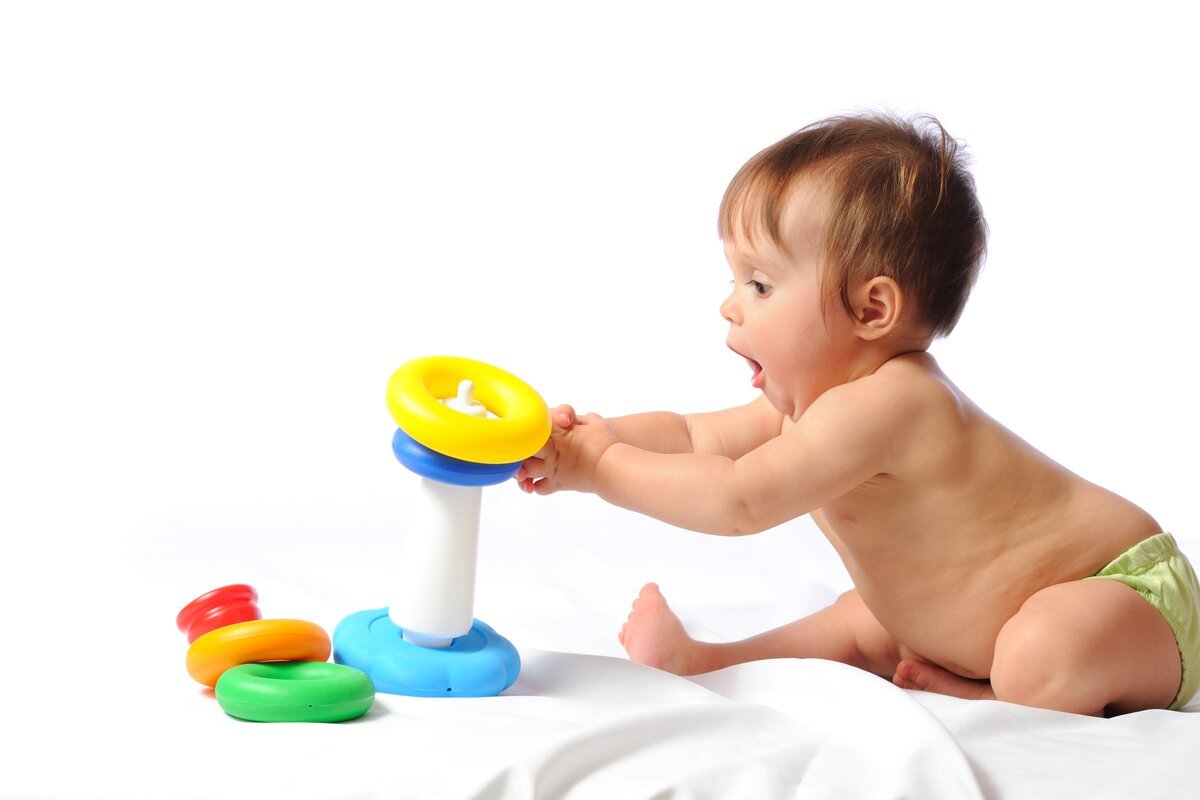
Toddlers at this stage are hungry for two things: language and small, satisfying problems to solve. Simple flash cards of animals, fruits and vegetables turn into a naming game long before your toddler can say the words back — the vocabulary is going in even while it looks like nothing is happening. Mosaic and peg boards, stacking rings and colour-matching sets build the fine motor control and early sequencing that lead, months later, into scribbling and stacking blocks with real intention. If you would rather start with what is already in your kitchen than buy anything new, our guide to brain development activities for babies using things at home is a good place to begin — the same principles apply, whatever toy or tumbler is in your baby’s hand.
One more thing worth building into the checklist, whichever age you’re shopping for: safety should never be an afterthought squeezed in after “cute” and “developmental.” Check for age-appropriate size (nothing that fits inside a toilet-paper roll for a baby who still mouths everything), non-toxic finishes, and sturdy stitching on anything with small attached parts. A toy that fails on safety fails full stop, however well it scores on the three tests above.
The purpose-card idea: why the same toy can do more
Here is the part almost every “best toys” list leaves out: the toy is only half the story. Hand a stacking ring set to two different parents and you will get two very different play sessions — one where the child is left to figure it out alone, and one where an adult sits down, names the colours, counts the rings, and turns it into fifteen minutes of real interaction. The object is identical. The developmental value is not.
This is the idea behind pairing every toy with a small purpose card — a plain-language note that says what a toy is actually building (grasp? cause-and-effect? early vocabulary?) and one or two ways to play it with your child. It takes the guesswork out of “am I doing this right” and turns a lovely object into a guided moment, which is precisely the interaction that builds the brain in the first place. It is also the thinking behind the play-kit series inside the Brainy Early Years packages — age-matched toys that arrive with exactly this kind of guidance, so a parent never has to guess whether a toy is “developmental” or just pretty.
Why curated beats expensive — especially this festive season
Diwali is exactly when this decision gets hardest. Grandparents want to spoil, well-meaning masis and periappas want to contribute, and by the time the last gold-wrapped box is opened, a toddler can be sitting in front of more toys than they will ever really play with in a year. More is not the same as better. A child faced with twenty toys tends to sample each for thirty seconds and settle on none; a child faced with five well-chosen, age-matched toys tends to go deep — and depth, not variety, is what builds a skill.
So if there is one thing worth telling family members who ask “what should we get her”: a smaller, curated, age-matched set will do more for your child’s development than a large, expensive one bought off a general bestseller list. That is also, practically, what curated play kits are for — a rotating set of about five items every few months, each chosen for exactly the stage your child is in, so the toy box never becomes a pile and never goes stale. You can browse age-matched ideas any time in our Activity Library, or let a curated series do the choosing for you.
Whichever way you go this festive season, the underlying rule doesn’t change: a toy is only as developmental as the attention it invites. Choose fewer, choose matched to the stage, and sit down on the floor with your baby more often than you shop for them. Develop the brain first. Everything else follows.